Jab Rajasthan mein loo chalti hai — jab garam hawaon mein even chhaya mein baithe baithe pasina bahne lage — tab ek chhota sa delay life and death ka fark ban sakta hai. Heat stroke is not just "garmi lagna." It is a life-threatening medical emergency. And yet, most people still don't know how to …

Jab Rajasthan mein loo chalti hai — jab garam hawaon mein even chhaya mein baithe baithe pasina bahne lage — tab ek chhota sa delay life and death ka fark ban sakta hai. Heat stroke is not just “garmi lagna.” It is a life-threatening medical emergency. And yet, most people still don’t know how to respond correctly when it happens — right in front of them.
Every summer, temperatures in Rajasthan routinely cross 45–48°C. Cities like Jaipur, Jodhpur, Bikaner, and Barmer are among the hottest in the country. Construction workers, farmers, schoolchildren, pilgrims, and even tourists face the silent threat of heat-related illness every single day between April and July.
The problem isn’t just the heat. It’s the fact that most of us don’t know the difference between heat exhaustion and heat stroke — and more critically, we don’t know what to do in the first five minutes when someone collapses. Those first minutes can genuinely save a life.
In this guide, we’ll break it down simply and practically — no complicated medical jargon — so that anyone, from a school teacher to a shopkeeper, can recognise and respond to heat stroke before medical help arrives.
What Exactly Is Heat Stroke — And Why Is It Different From “Normal” Garmi?
Heat stroke (also called sun stroke or lू लगना in Hindi) is a severe medical condition that occurs when the body’s core temperature rises above 40°C (104°F) and the body loses its ability to cool itself down. Unlike heat exhaustion — which is serious but manageable — heat stroke can cause permanent brain damage, organ failure, and death within minutes if not treated immediately.
Understanding the progression helps:
The Heat Illness Spectrum
- Heat Cramps: Muscle pain or spasms, usually in legs or abdomen. Body is still managing.
- Heat Exhaustion: Heavy sweating, cold/pale/clammy skin, fast but weak pulse, nausea, dizziness. Person is still conscious and sweating.
- Heat Stroke: Body temperature above 40°C, hot and red skin (may be dry or damp), rapid strong pulse, possible confusion, slurred speech, or loss of consciousness. This is a medical emergency — call 108 immediately.
The key warning sign that separates heat stroke from heat exhaustion is altered mental state — confusion, irritability, slurred speech, or unconsciousness. If someone in the heat starts acting confused or passes out, treat it as heat stroke until proven otherwise.
Who Is Most at Risk in Rajasthan’s Summer?
While heat stroke can affect anyone, certain groups face significantly higher risk given Rajasthan’s climate and socioeconomic context:
High-Risk Groups in Rajasthan
- Outdoor workers — construction labourers, agricultural workers, NREGA workers who work under open sky from 10am to 4pm
- Children and elderly — their bodies thermoregulate less efficiently
- Pilgrims and tourists — unfamiliar with local heat intensity, often dehydrated
- People with chronic illness — diabetes, heart disease, hypertension increase vulnerability
- Those on certain medications — diuretics, antihistamines, beta-blockers reduce heat tolerance
- People who are not acclimatised — someone who just arrived from a cooler city is at high risk
“Ek healthy adult bhi, agar sunscreen aur paani ke bina duphar ki loo mein 2 ghante reh jaaye, heat stroke ka shikaar ho sakta hai.”
Recognising Heat Stroke: Symptoms You Must Know
Fast recognition is everything. Memorise these symptoms — and teach them to your family members too:
🚨 Classic Heat Stroke Symptoms
- High body temperature (above 40°C / 104°F)
- Hot, red, dry or damp skin
- Rapid, strong heartbeat (tachycardia)
- Throbbing headache
- Nausea or vomiting
- Confusion, altered behaviour, slurred speech, or disorientation
- Loss of consciousness / unresponsiveness
- No sweating despite extreme heat (in classic heat stroke)
Note: In exertional heat stroke (common in labourers and athletes), the person may still be sweating heavily. Absence of sweat doesn’t always mean the person is safe — always check for confusion and body temperature.
First Aid for Heat Stroke: The Step-by-Step Response
Every second counts. Here is what you should do the moment you suspect someone has heat stroke:
01. Call for Emergency Help Immediately — Dial 108
Don’t wait to see if they “get better.” Call Rajasthan’s emergency number 108 (free ambulance service) right away. Heat stroke is a medical emergency and needs hospital care. Do the cooling steps below while waiting for help.
02. Move the Person to a Cool, Shaded Area Immediately
Get them out of direct sunlight. Move them indoors to an air-conditioned room if possible, or at least into deep shade with good air circulation. Do this within seconds of recognising the symptoms.
03. Cool the Person Down — This Is the Most Critical Step
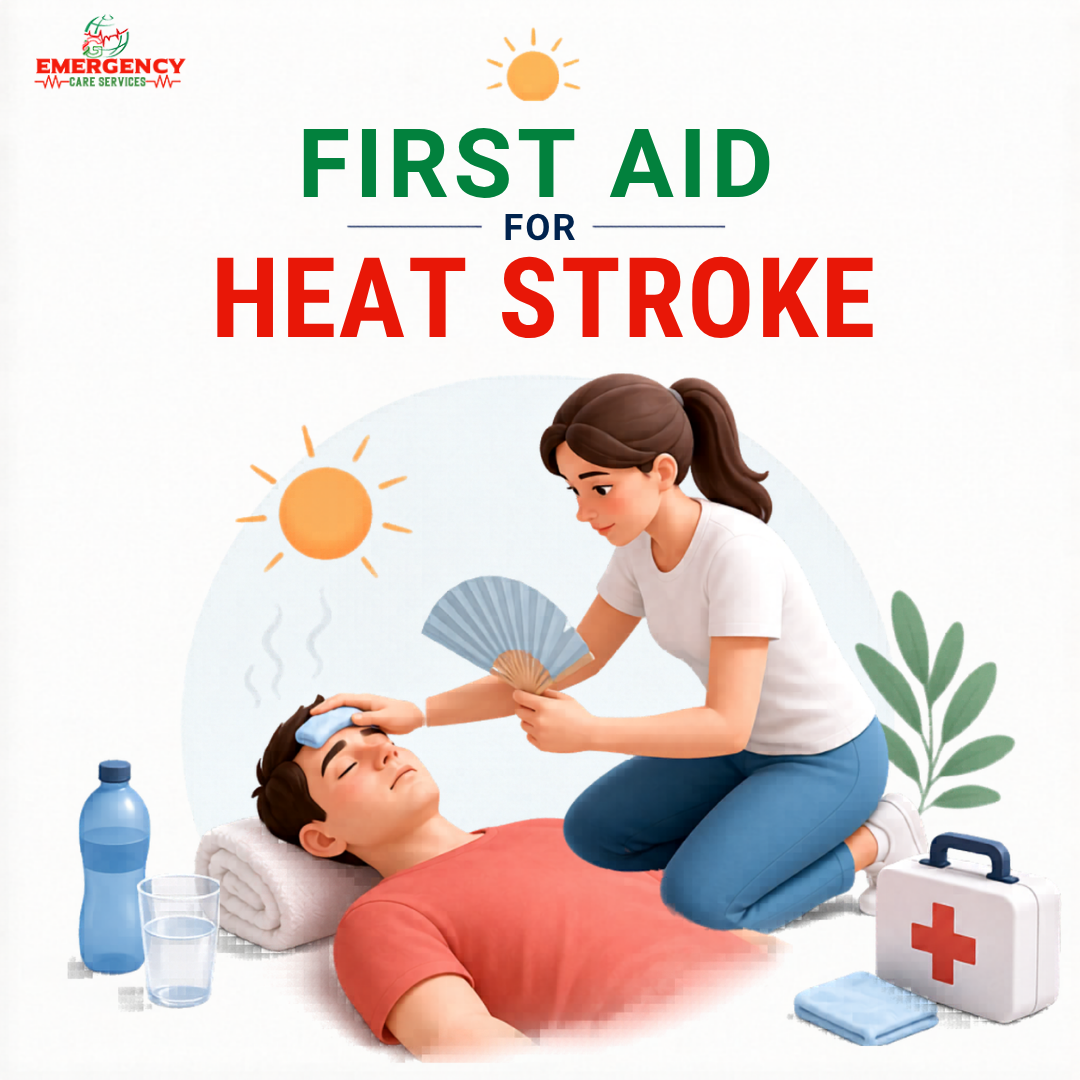
The goal is to lower their core body temperature as rapidly as possible. Use whatever you have: remove excess clothing, apply cold wet cloths or ice packs to neck, armpits, and groin (where major blood vessels are close to the skin), pour cool water over their body, fan them vigorously. If near a water source, immerse them in cool (not ice-cold) water.
04. Position the Person Correctly
If conscious, have them lie down with legs slightly elevated. If unconscious but breathing, place them in the recovery position (on their side) to prevent choking on vomit. Never give water orally to an unconscious person — they can choke.
05. Hydrate — Only If Conscious and Alert
If the person is fully conscious and can swallow safely, give them cool water or ORS (Oral Rehydration Solution) in small sips. Avoid drinks with caffeine or alcohol. Do not force fluids — nausea and vomiting are common in heat stroke.
06. If Unconscious — Check Breathing and Start CPR if Needed
If the person is unresponsive and not breathing normally, begin CPR (Cardio-Pulmonary Resuscitation) immediately. Knowing how to perform CPR can literally save a life in this situation. Continue until emergency services arrive. If you don’t know CPR, now is the time to get certified.
07. Continue Monitoring Until Help Arrives
Keep cooling the person, talk to them reassuringly, monitor their breathing, and do not leave them alone. Keep a note of when symptoms started — this information is critical for the medical team.
What to Do — and What NOT to Do
✅ DO These Things
- ✓ Call 108 immediately
- ✓ Move the person to shade/cool area
- ✓ Apply ice packs to neck, armpits, groin
- ✓ Fan continuously while misting with cool water
- ✓ Give ORS or cool water if conscious and alert
- ✓ Place unconscious person in recovery position
- ✓ Start CPR if person is not breathing
- ✓ Stay with them until ambulance arrives
❌ DON’T Do These Things
- ✗ Give water or food to an unconscious person
- ✗ Use ice-cold immersion (can cause shock)
- ✗ Give aspirin or paracetamol — they don’t help in heat stroke and can cause harm
- ✗ Leave the person alone
- ✗ Assume they’ll be fine and “wait and watch”
- ✗ Give alcohol or caffeine-based drinks
- ✗ Apply oil or ghee (a common home remedy — this traps heat)
Prevention: How to Stay Safe in Rajasthan’s Summer
The best first aid is prevention. Here are practical, ground-level tips that work specifically in Rajasthan’s climate:
Hydration Is Non-Negotiable
Drink at least 3–4 litres of water daily during peak summer, even if you don’t feel thirsty. Thirst is a late indicator of dehydration — by the time you feel thirsty, your body is already behind. Add ORS, nimbu paani (lemon water), chhachh (buttermilk), or coconut water to your routine. These are not just traditional refreshers — they’re scientifically effective electrolyte replenishers.
Avoid the Peak Heat Hours
In Rajasthan, outdoor work or travel between 11am and 4pm during May–June is genuinely dangerous. If you must be outside, wear light-coloured, loose, full-sleeved cotton clothing, use a dupatta or cap, and carry water.
Never Leave Children or Elderly in Parked Cars
A parked car in Rajasthan’s summer can reach 60–70°C inside within minutes. Even with windows cracked. This is a leading cause of preventable heat stroke deaths in children. Never, ever do this — not even for “just 5 minutes.”
Look Out for Your Neighbours
Check on elderly neighbours, especially those living alone, during extreme heat days. Social isolation is a real risk factor for heat-related deaths among the elderly.
“According to the National Health Portal of India, heat stroke is entirely preventable — but it requires awareness, preparation, and community response.”
Why Every Indian Should Know Basic First Aid and CPR
In a country of 1.4 billion people, emergency response infrastructure is stretched thin. An ambulance in a metro city may take 8–15 minutes. In rural Rajasthan, it can take far longer. In that window — before professional help arrives — a bystander who knows basic first aid is the most powerful healthcare resource available.
Heat stroke is just one of many emergencies where first aid knowledge makes a decisive difference. First Aid and CPR training doesn’t require a medical background. G Emergency Care Services — Rajasthan’s only AHA-certified training centre — offers hands-on, simulation-based programmes specifically designed for non-medical individuals, working professionals, and community volunteers.
Our Basic Life Support (BLS) Training programme, in particular, covers the emergency response skills that directly apply to situations like heat stroke — including airway management, CPR, and recovery positioning. It’s a 4–6 hour course that can genuinely make you the difference between life and death for someone you love.
🎓 Get Certified. Be Prepared.
Join Rajasthan’s most trusted AHA-certified First Aid, CPR & BLS training centre. Whether you’re a healthcare professional, school teacher, corporate employee, or a concerned citizen — we have a programme for you.
Enroll in First Aid Training →A Quick Revision: Heat Stroke Emergency Checklist
📋 Heat Stroke First Aid — Quick Reference
- 🔴 Recognise: High body temp, confusion, hot red skin, rapid pulse
- 📞 Call: Dial 108 for emergency ambulance
- 🌡️ Cool: Move to shade, apply ice packs, fan with cool mist
- 💧 Hydrate: Cool water/ORS if person is conscious and alert
- 🛏️ Position: Lie down with legs up; recovery position if unconscious
- ❤️ CPR: If not breathing — start CPR immediately
- 🏥 Do not stop: Continue cooling until medical help arrives
Final Words
Rajasthan ki garmi koi naya concept nahi hai. Hamaare buzurg bhi isi dhoop mein jeete the. Lekin aaj, jab hum unse kuch seekh sakte hain aur saath mein modern first aid knowledge bhi le sakte hain — to koi reason nahi ki ek preventable emergency, tragedy ban jaaye.
Whether you’re a parent, a school principal, a factory manager, or just a human being who cares about the people around them — learning these signs and steps takes less than 10 minutes of your attention. But applying that knowledge in the right moment? That can take someone from a life-threatening crisis back to their family.
Stay safe. Stay hydrated. And if you haven’t already — consider enrolling in a certified First Aid CPR training with G Emergency Care Services. Because emergencies don’t announce themselves. Preparedness does.
Heat Stroke First Aid Rajasthan Summer Safety Heat Stroke Symptoms Loo Lagna Treatment Emergency Response India CPR Training Jaipur Summer Health Tips First Aid Rajasthan
Stay Cool. Stay Safe.
Rajasthan’s extreme summer heat can turn dangerous in minutes. Learn how to recognize heat stroke symptoms, provide immediate first aid, and protect yourself and your loved ones during scorching temperatures.
Disclaimer: This article is for educational and awareness purposes only. It is not a substitute for professional medical advice, diagnosis, or treatment. In any medical emergency, always call 108 (Rajasthan Emergency Services) or rush the person to the nearest hospital immediately.